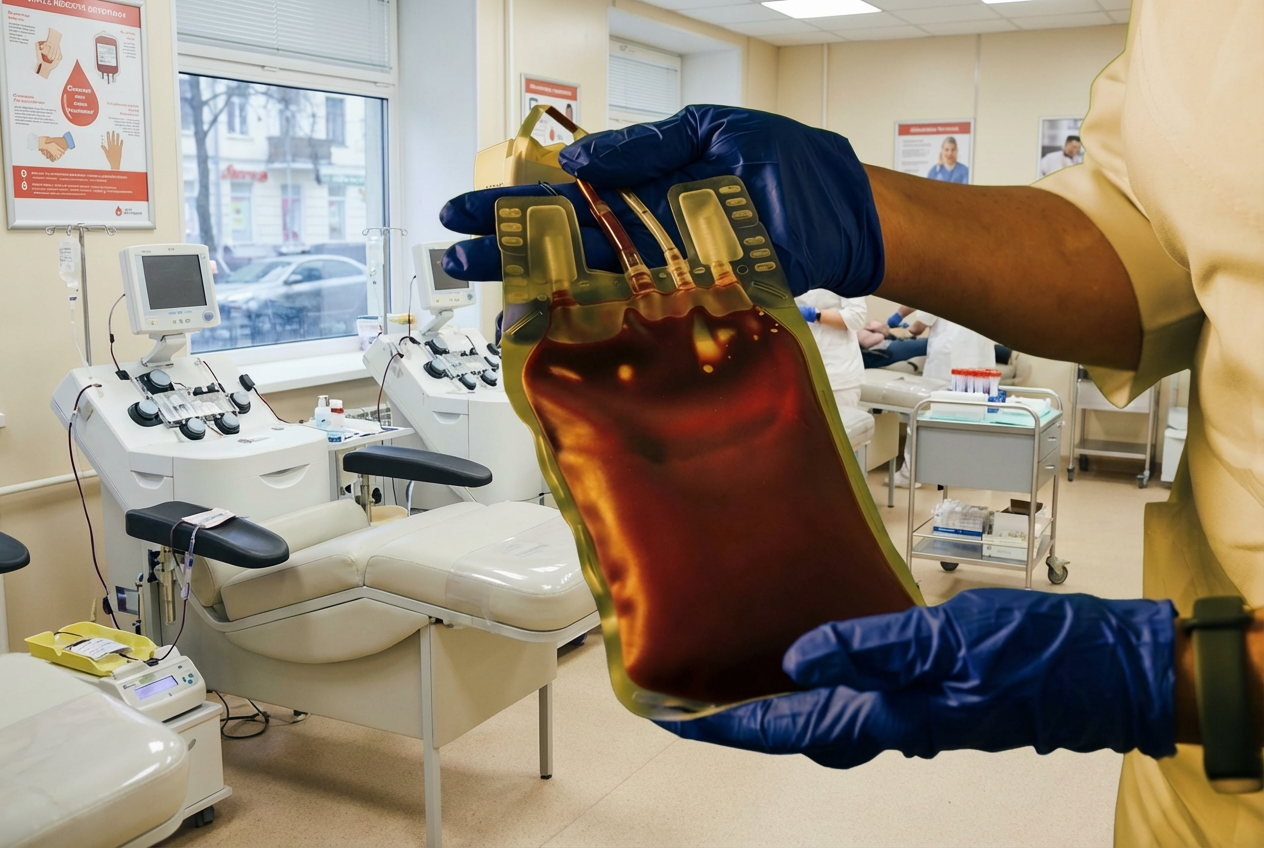
Public transfusion systems carry a strange paradox: they are highly regulated, clinically critical and life-saving—and yet they often run on paper forms, Excel files and heroic improvisation.
This case comes from a provincial health network in Latin America, with multiple hospitals, blood banks and laboratories working together to secure blood for its population. Before the intervention, the system “worked” thanks to the experience and dedication of its people, not because the infrastructure helped them.
National and provincial health authorities, together with international organisations, launched a multi-year effort to fix that. The aim was not to install yet another IT system, but to redesign the transfusion ecosystem as a modular, interoperable platform that could respect how things were done in the field and still raise the bar.
One of the consultants leading the design and delivery of this programme—bringing experience from large-scale process, retail, e-commerce and digital platform work—is now part of Matekraft. This is the story of that transformation and the lessons we carried forward.
Before: what was broken
Before the programme started, the transfusion system operated in a fragile, fragmented way. The risks were not theoretical.
Information & traceability
- Donor data, serology results, stock levels and transfusion records lived in different silos: paper forms, Excel sheets, legacy lab systems and local databases that did not talk to each other.
- Along the chain from donation to transfusion, there were “black holes” where units left the formal trace and were very hard to follow end-to-end.
- There was no reliable, shared view of:
- how much blood and which haemocomponents were available,
- where they were physically located,
- and when each component would expire.
Operations & workflows
- Donor questionnaires were long, static and difficult to handle as real conversations. Quality depended heavily on the individual professional.
- Each hospital and laboratory had slightly different practices for serology, discards, fractionation and stock rotation.
- Small centres (“effectors”) often had:
- no dedicated computers for transfusion processes,
- no barcode scanners,
- no label printers,
- and limited connectivity.
Governance, risk & integrity
- Multiple authorities were involved: national ministry, provincial ministry, provincial directorates, hospital management, international organisations.
- There was no single, coherent roadmap; initiatives appeared and faded over time.
- Because stock was opaque, it was hard to distinguish:
- normal variation and inefficiency,
- from potentially improper or even illegal uses of blood products.
- Decisions about campaigns, production and distribution were often based on intuition and local experience, not shared data.
In short: the system relied on committed people compensating for weak tooling. That is not sustainable in a domain where mistakes and misalignments have heavy consequences.
The intervention: from audit to architecture
The programme started with a simple decision: don’t rush to build—start by seeing.
Step 1 – Audit and mapping
A transversal audit was carried out across the province:
- visits to large hospitals and small rural centres,
- interviews with technicians, nurses, biochemists, doctors, directors,
- analysis of existing software, lab systems, paper flows and informal Excel files.
The team mapped:
- how donors moved through facilities (reception, interview, extraction, waiting),
- how blood and haemocomponents moved (collection, transport, processing, storage, distribution),
- how information was (or wasn’t) recorded at each step,
- where decisions were taken and by whom.
This produced a detailed picture of formal procedures and actual practice, and clearly surfaced the “black holes” where traceability and control broke down.
Step 2 – Target model and modular architecture
Instead of proposing a single monolithic replacement, the target was a modular, interoperable system covering the entire transfusion chain:
- Donor & history module
Unified donor identity, contact data (with redundancy for sensitive follow-up like HIV), questionnaire history and donation history. - Questionnaire & serology module
Dynamic questionnaires, logical branching, linkage to serology results and immunohaematology algorithms. - Stock & haemocomponents module
Real-time view of units by group, factor, haemocomponent, status and expiry, across multiple sites. - Transfusion & haemovigilance module
Linkage of units to patients and episodes, events and adverse reactions, follow-up and reporting. - Plasma quality & certification module
All the information needed to certify plasma as raw material for industry, including origin and processing details. - Statistics & production simulation module
Data for planning campaigns, production and fractionation, bringing in concepts and models from retail and e-commerce stock management.
These modules were not just conceptual; they provided a clear contract for data and integration.
Step 3 – Programme structure
The work was organised into phases:
- Audit & diagnostic – build a shared understanding of reality.
- Architecture & target model – design the modular system and integration strategy.
- Pilots in selected sites – run the new system in controlled but realistic environments.
- Progressive expansion & enrichment – add features such as advanced haemovigilance, extend to more centres, refine flows and tools.
Each phase had tangible outputs: maps, models, working software, improved indicators in pilot sites. Value appeared early and often, not only at the end.
Three lenses to read this case
You can read this case from three complementary perspectives: architecture, governance and frontline experience. Each one addresses different aspects of the same transformation.
Lens 1 – Architecture & interoperability
This lens answers: how did the system start to think and connect as one network?
Key issues
- Systems in labs, hospitals and banks of blood were disconnected or poorly integrated.
- There was no common data language to reliably exchange vitally important information.
- The province had a private MAN (metropolitan area network) connecting centres, but it was underused and unevenly leveraged.
- Many centres had partial or unstable connectivity.
What we did
1. Adopted HL7 as the shared language
- HL7 was chosen as the interoperability backbone between:
- existing lab systems,
- the new transfusion platform,
- and, where available, electronic health records.
- The team did not aim for theoretical “full HL7 compliance” from day one.
- Instead, they focused on the most critical message types: serology results, unit statuses, key patient identifiers.
2. Defined a modular architecture with clear data contracts
- Each module (donors, serology, stock, transfusion, haemovigilance, quality, statistics) had:
- clear responsibilities,
- explicit events and state transitions,
- defined interfaces to others.
- Units of blood and haemocomponents were modelled as entities moving through states:
- collected → transported (with temperature) → processed → fractioned → irradiated (where needed) → stored → dispatched → transfused → discarded (with reason) when applicable.
3. Central + local by design
- The provincial MAN enabled a hybrid architecture:
- a central database for consolidated traceability, stock and reporting,
- combined with local components able to keep working during connectivity issues.
- Large hospitals could operate almost fully online; small centres could:
- run essential operations locally,
- synchronise when the connection allowed.
4. Standardised labels and barcodes
- Labels and barcodes became first-class citizens:
- each unit received a unique, trackable identity,
- key steps (collection, transport, reception at blood bank, processing, fractionation, issue, transfusion, discard) were recorded through scanning, not manual typing.
- The system supported both:
- distributed label printing where printers were available,
- centralised label printing for smaller centres with limited equipment.
Why it worked
- End-to-end traceability was now possible:
- units no longer “disappeared” from the system,
- investigations and audits had a reliable digital trail.
- The platform could co-exist with existing lab and hospital systems instead of trying (and failing) to replace them all at once.
- The architecture naturally supported gradual evolution: new modules, better integrations, richer analytics, without redesigning everything from scratch.
Lens 2 – Governance & delivery
This lens answers: how did the project survive complexity, politics and time?
Key issues
- There was no single “client”: national ministry, provincial ministry, international organisations and local authorities all had stakes.
- Each layer had different timelines, incentives and constraints.
- Teams in the field had seen many initiatives come and go; scepticism was real.
- Changes in political leadership could easily disrupt or cancel the programme.
What we did
1. Mapped stakeholders and power
- The team identified:
- formal decision-makers (ministers, directors),
- informal leaders (respected clinicians, lab chiefs),
- potential blockers (people whose work would change the most).
- This mapping informed who needed:
- to be informed,
- to be involved in design,
- to endorse key decisions.
2. Structurally phased the programme
- The work was split into phases with clear entry and exit criteria:
- Audit & diagnostic
– gave everyone a shared picture of problems and “black holes”. - Target architecture & model
– created a credible future, not just critical slides. - Pilots
– proved that change was possible without breaking everything. - Expansion & enrichment
– scaled what worked, added layers like haemovigilance.
- Audit & diagnostic
- Each phase delivered something of standalone value:
- The diagnostic itself helped shape policy.
- Early pilots visibly improved traceability and stock handling.
3. Built credibility through visible wins
- Pilots were chosen carefully to represent:
- different sizes of centres,
- varying levels of digital maturity,
- and different geographic realities.
- Early successes included:
- tracking stock flow where it had never been fully visible,
- reducing waste by rotating units between hospitals before expiry,
- closing gaps where units used to “disappear” from the records.
4. Anchored the programme in respected technical leadership
- Provincial experts in haemovigilance, quality and transfusion medicine were involved from the beginning.
- Their role:
- validate clinical logic and safety,
- champion the system among peers,
- ensure the programme stayed aligned with best practice, not just IT constraints.
Why it worked
- The project was not perceived as “another IT system”, but as a systemic improvement with clear benefits at each step.
- Multiple sponsors stayed engaged because they saw concrete results, not only plans.
- When political and organisational winds shifted—as they always do—the programme had enough proof and allies to continue.
Lens 3 – Frontline experience & culture
This lens answers: did the system actually help the people doing the work?
Key issues
- Donor questionnaires were long, rigid and hard to use in real conversation.
- The physical layout of centres imposed strict flows; people and blood could not simply move “backwards”.
- Many small centres lacked digital tools to properly register and trace their work.
- Critical knowledge (e.g. when irradiation is required, how to manage adverse events) lived in manuals or senior staff’s heads.
What we did
1. Turned the donor questionnaire into a guided interview
- The questionnaire became a dynamic, branching flow:
- follow-up questions appeared only when relevant,
- epidemiologically or legally critical questions could not be skipped,
- the structure supported a natural dialogue between professional and donor.
- Specific care was taken with:
- HIV-related questions and other sensitive topics,
- ensuring the system supported legal requirements for contact data and follow-up.
2. Mirrored physical flows with roles and permissions
- The system was designed around stations that matched the real physical journey:
- reception,
- interview,
- extraction,
- laboratory,
- blood bank,
- transfusion sites.
- Each role had a tailored view:
- reception staff see what they need to admit and route donors,
- interviewers focus on questionnaires and eligibility,
- lab staff handle serology and sample management,
- blood bank teams manage processing, fractionation, irradiation, storage and dispatch,
- transfusion teams record use and reactions.
- This reduced unnecessary navigation and data duplication, and aligned the digital flow with how buildings and teams actually work.
3. Brought digital tooling to the periphery
- Pilot and subsequent waves included:
- deployment of dedicated computers in centres that previously had none,
- installation of barcode scanners,
- rollout of label printers where meaningful.
- Where local printers were not feasible, the system supported:
- centralised printing of labels and materials, still keeping IDs and traceability consistent.
4. Embedded knowledge into the interface
- For steps with complex clinical implications (e.g. haemovigilance, irradiation, specific haemocomponents), the interface provided:
- links to relevant protocols,
- guidance on classification of adverse events,
- reminders of key definitions.
- Instead of forcing staff to leave the system and search for PDFs or binders, the platform became a gateway to the right knowledge at the right moment.
Why it worked
- Frontline staff recognised their own work in the system; it felt like a translation of reality, not an abstract process model imposed from outside.
- Critical steps (eligibility, serology, haemovigilance) became more consistent across centres and shifts.
- The system reduced cognitive load during stressful situations, especially in emergencies and night shifts.
- Small centres, historically at the edge of the network, were more integrated into the provincial view and standards.
Outcomes: what actually changed
The impact of the programme can be read across several dimensions.
Operational & clinical
- Traceability
End-to-end digital tracking of units from donor to recipient in pilot and early expansion sites. - Cycle times
Measurable reduction in the time between transfusion request and availability of compatible units, thanks to clearer stock visibility and better coordination. - Waste reduction
Lower haemocomponent waste due to:- earlier visibility of upcoming expiries,
- rotation of units between hospitals,
- better handling of discards at each stage.
Integrity & transparency
- Black holes closed or exposed
Units that previously “disappeared” from the records now had a clear digital trail. Any remaining anomalies were easier to detect and investigate. - Less room for misuse
Transparent stock and movement information reduced the opportunity for informal or fraudulent use of blood products. - Accountability
Clearer attribution of actions (who did what, when, at which step) increased accountability in discards, transfers and usage.
Data & planning
- Production simulations
The system enabled simulations of production capacity based on:- current stock,
- expected donations,
- typical processing yields,
- demand patterns.
- Smarter campaigns
Donation campaigns could be planned around projected needs instead of generic “we always need more blood” messaging. - Policy insights
Authorities gained a better understanding of:- which centres needed investment,
- which practices led to more waste,
- where additional training or equipment would have the highest impact.
From transfusion to everything else: what Matekraft carries forward
This case was born in public health, but the patterns apply far beyond it: to banking platforms, telecom operations, logistics networks and any other complex, regulated environment.
At Matekraft, we distilled several principles from this experience:
- Architecture must respect reality but refuse to be captive to it.
You don’t start from a blank slate; you start from messy, overlapping systems. Good architecture creates a path from that mess to something coherent, step by step. - Programme governance is as important as the system design.
Multi-actor environments are the norm, not the exception. Mapping power, sequencing phases and delivering value early is what keeps long transformations alive. - Tools should behave like teammates, not supervisors.
If the interface doesn’t help people in the moments that matter, it will be bypassed. Designing with frontline staff is non-negotiable. - Stock and flow thinking travels well.
Concepts from retail and e-commerce—stock levels, thresholds, simulation, rotation—are powerful when adapted carefully to critical domains like healthcare. - Knowledge has to live where work happens.
Protocols, standards and best practices belong in the tools people use every day, not only in documents and training sessions.
This transfusion programme was not just “an IT project”. It was a socio-technical redesign of a vital public system. The same combination of architecture, governance and human-centred design now underpins how Matekraft approaches complex digital initiatives in other sectors: calm, precise and relentlessly focused on real-world impact.